Ask ten contractors whether a walk-in shower or a soaking tub adds more value and you will get ten confident answers, most of them wrong. The honest answer is that the walk-in shower vs. soaking tub question has no universal winner, and anyone who gives you one without asking about the rest of your house is guessing.
The variable that decides it is not style, budget, or trend. It is how many other bathtubs your home has.
Get that one input right and the rest of the decision follows almost mechanically. Get it wrong and you can spend $30,000 on a beautiful primary bath that narrows your buyer pool at closing. Below is what the resale data actually shows, what buyer preference research says, what each option costs in the Austin market, and a short framework for deciding on your own home.
The Short Answer
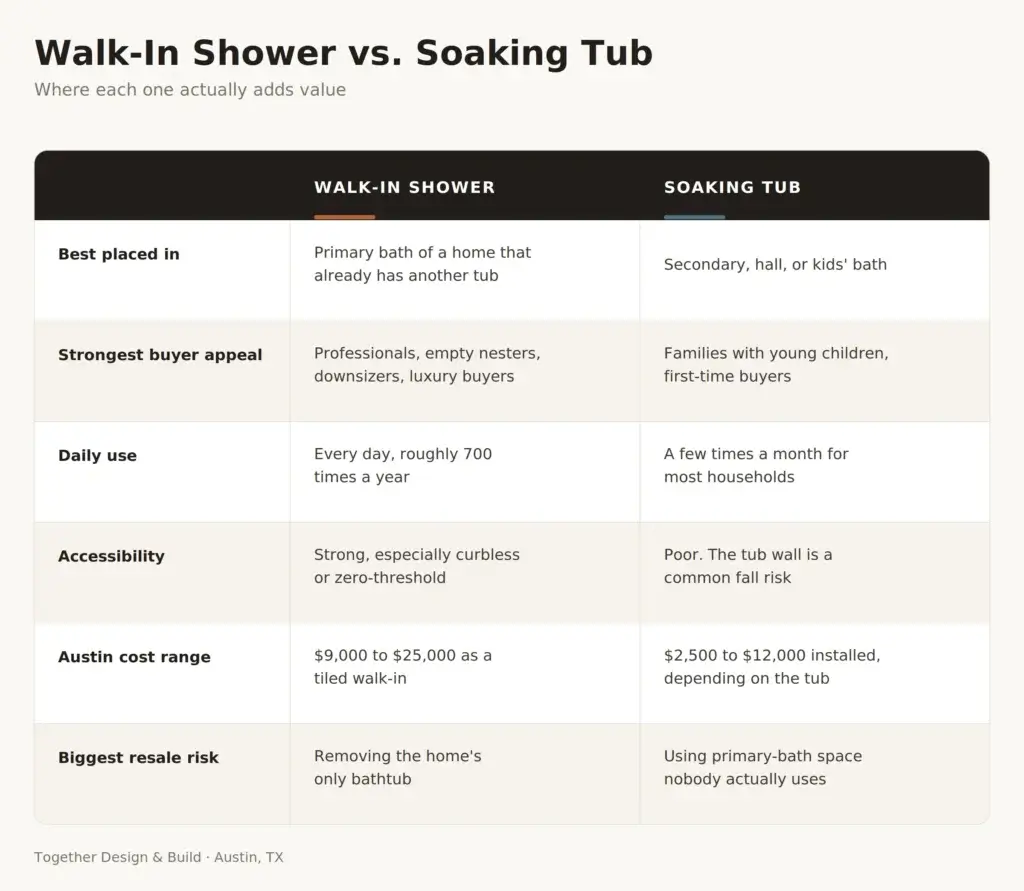
A walk-in shower adds more value in the primary bathroom of a home that has at least one bathtub somewhere else. A soaking tub adds more value when it would be the only tub in the house, particularly in a three-bedroom or larger home in a family neighborhood.
That is the whole rule, and it holds across almost every market study on the subject.
What Do the ROI Numbers Actually Say?
Bathroom remodels return roughly 50 to 80 cents on the dollar at resale, and the spread between those two figures is not noise. It reflects two research methods measuring two different things, which is why homeowners find contradictory numbers online and give up.
Zonda’s annual Cost vs. Value Report, produced with the Journal of Light Construction, prices a tightly defined project scope and then surveys thousands of real estate professionals on what that specific scope adds to a sale price. By that method, a midrange bathroom remodel recovers about 80% of its cost nationally. Universal design and accessibility-focused bathrooms recover around 61%, a figure that jumped roughly 12 points in a single year as aging-in-place demand rose. Upscale bathrooms land far lower, often in the 36% to 45% range.
The National Association of Realtors and NARI take the opposite approach in their Remodeling Impact Report, comparing remodeler cost estimates against what agents believe a broad renovation category contributes. That method produces the 50% figure. Neither is wrong. They are answering different questions.
You can read Zonda’s summary of the most recent report at their Cost vs. Value announcement. The report’s own authors are clear that national modeling cannot predict the outcome at any single address.
Locally, Austin bathroom remodels tend to recoup in the 62% to 68% range, and mid-range projects nationally return 65% to 80%. The pattern in every one of these datasets is identical: restraint pays. Midrange scopes outperform luxury scopes, consistently and by a wide margin.
Here is what none of those reports measure. They price a bathroom remodel. They do not price the fixture decision inside it. No study isolates “walk-in shower” against “soaking tub” as a line item, because the variable that matters is not the fixture. It is what the fixture leaves behind.
Why Removing Your Only Bathtub Is the Real Risk
Buyer preference research is consistent on this point. The National Association of Home Builders has found that a large majority of buyers, around 78% in its feature preference work, rate both a shower stall and a tub in the primary bath as essential or desirable, and roughly 72% of first-time buyers consider a bathtub essential or desirable somewhere in the home.
Notice what that data does not say. It does not say the tub has to be in the primary bathroom.
That distinction is the entire strategy. A buyer touring a four-bedroom house in Circle C with two small children is not running a stopwatch on where the tub is. They are checking that one exists. If it does not, the house drops off their list before they reach the backyard, and you never learn why the offer did not come.
The exposure is concentrated in a specific kind of property: three or more bedrooms, in a neighborhood that sells to families. Around Austin that describes a great deal of inventory in Circle C, Steiner Ranch, Avery Ranch, Mueller, Cedar Park, Round Rock, and Pflugerville. In those homes, converting the last tub in the house to a shower is a decision to sell to a smaller audience.
The exposure nearly disappears in a downtown or Rainey Street condo, a one-bedroom garage apartment, or a two-person household in Tarrytown or Westlake where the buyer pool skews toward professionals and downsizers.
When the Walk-In Shower Wins
The walk-in shower is the stronger value play in these situations:
- Multi-bath homes. Your hall or guest bath keeps a tub-shower combo, and the primary bath gets the large tiled shower buyers now expect there. This is the default recommendation for most Austin primary suites.
- Primary suites under 100 square feet. A 60-inch drop-in tub plus a cramped 36-inch shower is a worse room than one generous shower. Consolidating buys you counter space, storage, and circulation.
- Aging in place. A curbless or low-threshold shower removes the highest fall risk in the house. Accessible bathrooms recover less of their cost on paper, around 61%, but that number ignores the value of not moving out of your home.
- Replacing a jetted tub nobody uses. A 1990s or 2000s whirlpool tub in a tiled deck is the most underused 25 square feet in most Austin houses, and buyers now read it as dated rather than luxurious.
Daily use is the argument nobody puts in a spreadsheet. You will step into that shower roughly 700 times a year. Value at resale matters once. Value in use matters every morning.
When the Soaking Tub Wins
The tub is the stronger play when:
- It is the only one in the house and the home has three or more bedrooms. This is the dominant case.
- Your buyer pool is families. School-district neighborhoods sell to people with small children, and small children get bathed, not showered.
- The tub goes in the secondary bathroom. A clean tub-shower combo in the hall bath is inexpensive, uncontroversial, and it protects the entire strategy, letting the primary bath go all-in on a shower.
- You genuinely use one. If you take two baths a week, build the tub. You are the one living there, and a fixture you use is never a bad investment.
One caution on the freestanding soaking tub specifically. It photographs beautifully and it is the most-requested feature in luxury primary baths across West Lake Hills and Lakeway, but a freestanding tub needs 4 to 6 inches of clearance behind it for cleaning, and a floor-mounted filler means running supply lines through a slab. Beautiful, and not free.
The Wet Room: Do You Have to Choose?
A wet room places a freestanding tub and a shower area inside one fully waterproofed, glass-enclosed zone. It has become the standard answer to this question in larger Austin primary suites, and for good reason: you get the everyday shower and the resale-friendly tub without the tub eating floor space in the middle of the room.
The waterproofing consolidates into a single contained area, which is easier to build correctly than two separate wet zones. The rest of the bathroom opens up for a longer vanity or a linen tower.
It needs room, though. Plan on 9 feet or more of clear wall to hold both fixtures with workable clearances, and expect the glass, tile, and drainage work to push the project into the upper tier of bathroom budgets. Below that width, a wet room becomes two cramped things instead of one good one.
What Each Option Costs in an Austin Bathroom
Most Austin bathroom remodels run $8,000 to $35,000, with the local market averaging near $25,000 in 2026 and primary suites reaching $60,000 or more. Within that, the fixture decision moves the number less than the plumbing decision does.
A tiled walk-in shower built into an existing shower footprint typically runs $9,000 to $18,000 depending on tile, glass, and niche work. Push it to a curbless design in a slab home and you add concrete cutting, drain relocation, and an expanded waterproofing footprint.
A soaking tub varies enormously by type. An alcove tub in an existing alcove is a modest line item. A freestanding tub with a floor-mounted filler in a new location is a different project, because the supply and drain have to come up through concrete.
That is the real cost driver in Central Texas. Nearly every home here sits on slab-on-grade, so moving any fixture means saw-cutting and trenching. Rough-in plumbing alone runs around $7,000 in Austin, and local trade rates sit between $75 and $150 an hour. Keeping fixtures where they already are is the single largest budget lever available to you.
Permits apply to almost all of this. Any remodel touching plumbing, electrical, or ventilation requires a City of Austin permit, which runs about $687 and covers building, electrical, plumbing, and mechanical review. You can confirm your situation through the City of Austin’s Development Services permitting resources, though we pull and schedule those ourselves on every project.
How to Decide for Your Own Home
Work through these in order. The first question usually settles it.
- How many bathtubs does the house have right now? If the answer is one and you have three or more bedrooms, keep a tub somewhere. Everything else is secondary to this.
- Who buys houses on your street? Walk a few open houses in your neighborhood. Family-heavy listings and adult-heavy listings look different, and the comps tell you which one you own.
- When are you selling? Inside three years, weight resale heavily. Beyond seven, weight daily use heavily. Ten years of a bathroom you love is worth more than a few thousand dollars of theoretical equity.
- How much room does the primary bath actually have? Measure it. A wet room needs width most primary baths do not have, and forcing one produces a worse result than choosing.
- Will you still want to climb into a tub in twenty years? If you plan to stay in the home, a curbless shower in the primary bath is the version of this decision that ages well.
A local agent can sanity-check questions two and three against current comps in your specific neighborhood, and that conversation costs nothing.
The Version That Works in Most Austin Homes
The layout that satisfies both the daily-use case and the resale case is not a compromise. It is a large walk-in shower in the primary bathroom and a clean tub-shower combo in the secondary bath. That configuration serves adults, kids, guests, and future accessibility without asking one fixture to do every job, and it is what we build most often across the Austin metro.
If your home only has one full bathroom, the answer changes. Keep the tub, or budget a wet room if the space supports it.
Together Design & Build runs design, material selections, permitting, and construction under one team on a fixed-cost contract, from our studio at 6000 S Congress Ave where you can compare tile, stone, and fixtures in person before committing.
Not sure which side of this your home falls on? Book a free in-home bathroom remodel estimate and we will walk the space, count the fixtures, check the slab and drain conditions, and give you a straight answer about what your house and your neighborhood actually support. You can also browse our completed Austin bathroom projects or ask about financing if timing is the constraint.
Call (512) 883-8401 or request your free estimate online.